Welcome to the 17th issue of Agents in Practice.
📬 Agents in Practice is a weekly newsletter on agentic AI research and applications. Subscribe here →
Helping research agents by forgetting
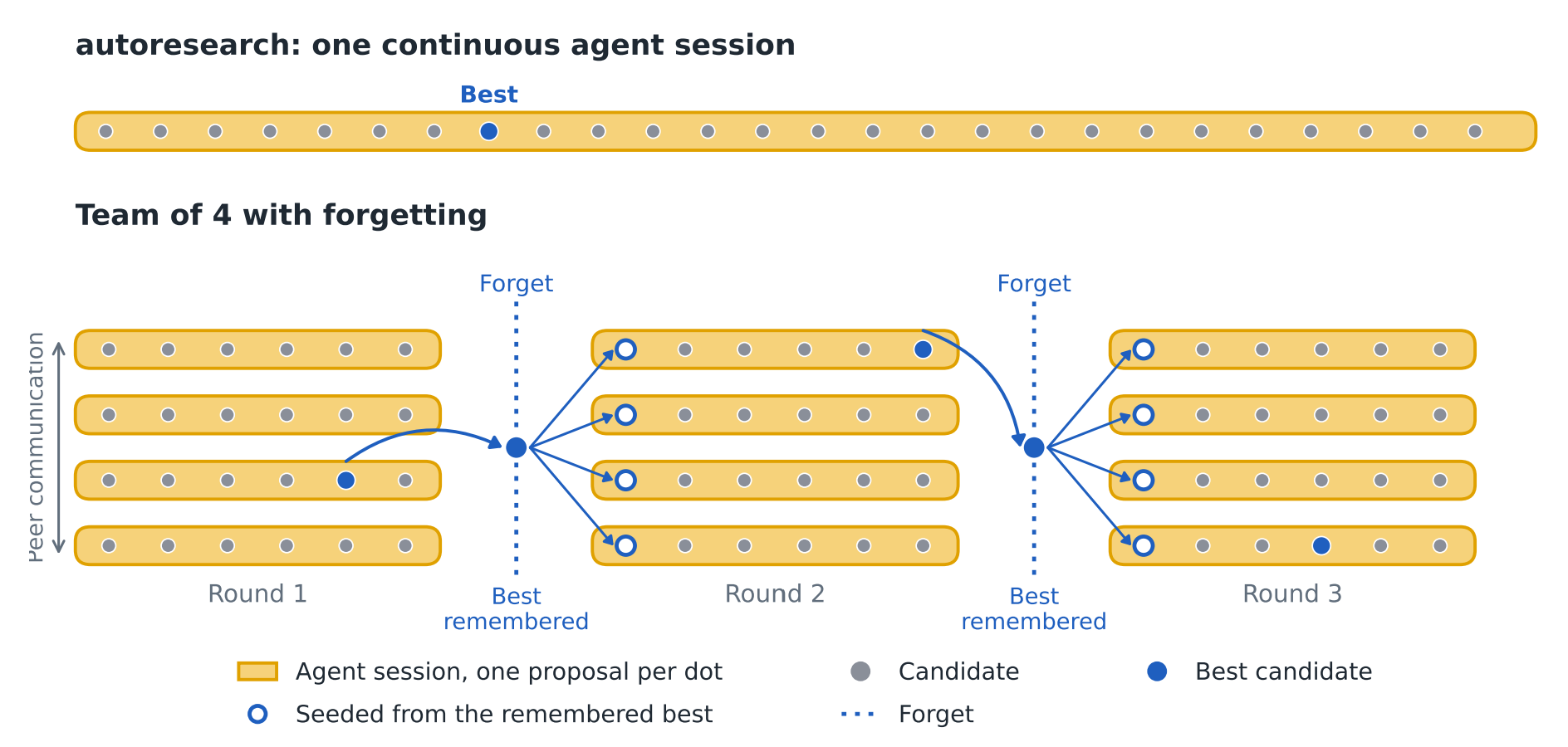
Researchers from UC Berkeley, Stanford, and Bespoke Labs study why automated research agents stop improving during long runs. They observe that agents make smaller edits and use less reasoning as their history grows, even when more budget remains.
The authors propose periodically discarding the agents’ conversation history and records of earlier candidates, keeping only the best solution found so far and its score. Fresh agents then start from that solution with the original instructions. They apply this to a team of four agents that can read one another’s candidate solutions and scores.
Across four optimization tasks, the team with forgetting outperformed both a single agent and four independent agents under the same spending budget.
Personal Thoughts
I also have AI scientist agents running ideation tasks, and I have observed similar phenomena where they rarely try to explore entirely new families of algorithms and focus on improving existing solutions. This approach reminds me of learning rate reset in deep learning, where periodically resetting the learning rate helps the model escape local minima and continue improving. It was the first ML paper I read, and it sure brings back memories!
Read more
How source preferences affect agent choices
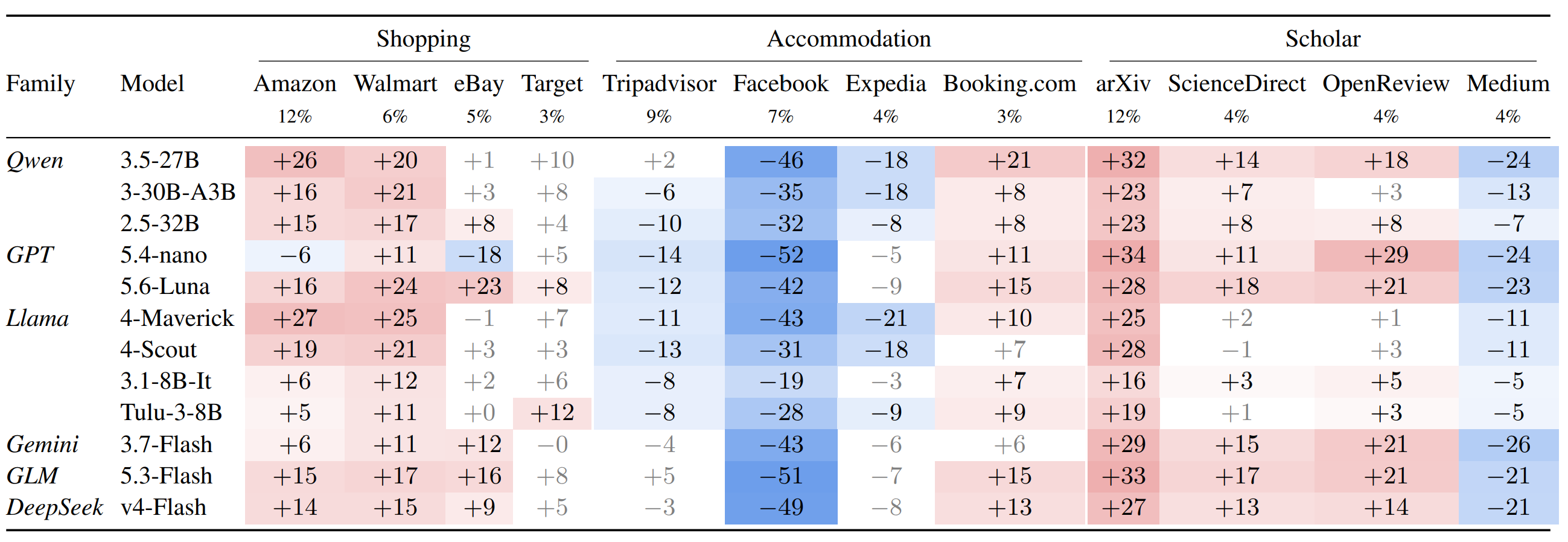
Researchers from Seoul National University study whether search agents favor particular websites, even when their results satisfy the user’s request equally well. They evaluate 12 models on shopping, accommodation, and academic searches, comparing results that match the same requirements while controlling for their position in the result list. An LLM judge assesses requirement satisfaction with source names and URLs removed.
Models often favor the same websites, sometimes choosing an item that satisfies one fewer requirement over a better match from a disfavored site. Among comparisons where exactly one item is selected, this happens at a median rate of 68% across model and domain combinations, compared with 2% when the source preferences are reversed. The authors’ experiments also show that hiding source names and URLs weakened the preference, while relabeling the same content with a preferred source increased selection.
Personal Thoughts
It would be interesting to analyze where this source preference effect comes from: whether it is from pretraining or post-training. If it can be directed by post-training, it opens up possibilities for controlling agent behavior to (1) reduce bias or (2) rank affiliated sources higher.
Read more
Personal Anecdote: More skills, same performance

This week, I created a skill for writing and reviewing tests for my agents. I had been a big fan of Google’s Testing on the Toilet posts that gave short tips for writing better tests. They were short while being informative, so I thought they would be a great candidate to turn into an agent skill. However, when I evaluated the review skill with both personal and open-source repos, I found it to have similar performance to reviewing without the skill, with slightly fewer total correct findings but slightly more findings of important issues. With how much agents have improved, it may be time for me to revisit my existing skills and how much can be removed without any detrimental impact. Considering how fast new frontier models come out, the key to keeping up with them may not be to carefully craft skills, but to have good evaluation for skills and to be able to quickly iterate on them.
One-liners
- On the model side, Moonshot released Kimi K3.1 Pro (Oct 23) through its apps and API, OpenAI released GPT-6.1 Terra (Oct 26), and Liquid AI released the open-weight LFM3 family (Oct 27). Kimi’s weights are promised by November 4. Google also announced Gemini 4 Carbon (Oct 28) with access starting with selected cyber defenders and trusted partners.
- GitHub opened Copilot Projects (Oct 28) in public preview, letting multiple agents work toward a shared goal across repositories and connected tools.
- Cognition upgraded Devin Security (Oct 26) with deep scans powered by Claude Mythos and other cyber models for enterprise customers, plus agents that reproduce vulnerabilities and test fixes in virtual machines.
Subscribe to Agents in Practice
Get new issues of Agents in Practice — a newsletter summarizing exciting new research and applications in agentic AI — delivered to your inbox.